
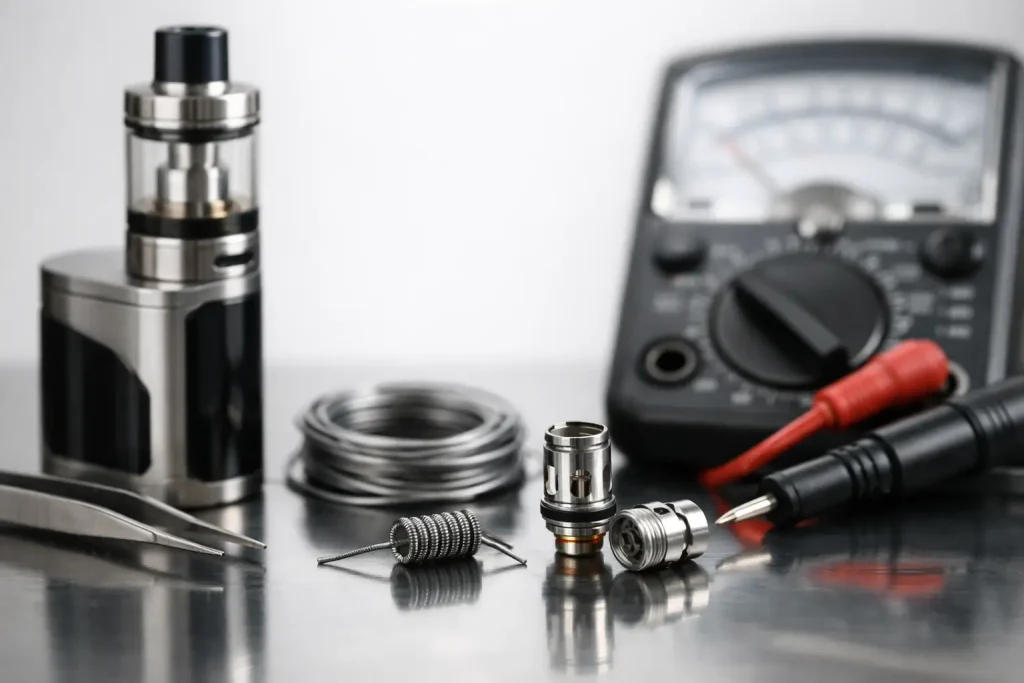
A replacement coil marked 0.6Ω or 1.2Ω can look like a small detail on the box, but it changes how your device performs. Understanding vape resistance and ohms makes choosing coils, setting wattage and avoiding a disappointing vape far simpler. It also helps you get the flavour, warmth and battery life you actually want from your kit.
Resistance is not about finding one ‘best’ number. A 0.8Ω pod coil can be an excellent everyday choice for one adult vaper, while a 0.2Ω mesh coil suits somebody else looking for more vapour at higher power. The right match depends on your device, e-liquid, nicotine strength and preferred draw.
What ohms mean in a vape coil
An ohm, shown with the Ω symbol, measures electrical resistance. In a vape coil, resistance describes how much the wire resists the electrical current sent from the battery. The coil heats when power passes through it, turning e-liquid held in the cotton into vapour.
A lower-resistance coil allows more current to pass through at a given voltage. It generally heats faster and needs more power. A higher-resistance coil restricts current more, so it usually works at lower wattage and produces a cooler, more restrained vape.
This is why two coils that physically fit the same pod or tank may feel completely different. The number is not a quality score. It is a guide to how that coil is designed to be used.
The simple relationship: resistance, power and heat
Vapers often refer to Ohm’s law because voltage, resistance and current are connected. Regulated vape devices handle much of that calculation automatically when you choose a wattage, but the principle still matters. Lower resistance, paired with appropriate power, creates more heat. More heat vaporises more e-liquid in a shorter time.
That can mean denser vapour and bolder flavour, but it also means faster liquid use, more frequent charging and a higher chance of a dry hit if the wick cannot keep up. Higher resistance uses less power and liquid, but may feel lighter and less warm. Neither approach is automatically better.
Low resistance vs high resistance vaping
Most modern devices are designed around a clear style of vaping. Looking at the coil’s resistance and recommended wattage range gives you a much better starting point than guessing from the appearance of the kit.
Lower-resistance coils
Coils below 1.0Ω are commonly used for restricted direct-to-lung or direct-to-lung vaping. You inhale the vapour more directly to the lungs, rather than drawing it first into the mouth like a cigarette. These coils often use mesh, a wider heating surface that can deliver strong flavour and generous vapour.
A coil around 0.15Ω to 0.6Ω commonly needs medium to high wattage, depending on the exact tank or pod. It works best with airflow opened further and e-liquid that wicks efficiently. Because it produces more vapour per puff, lower nicotine strengths are usually more comfortable for many users.
The trade-off is straightforward: low resistance uses more of everything. Expect e-liquid consumption to rise, battery charge to fall faster and coils to need regular replacement. This is a good choice for adults who prioritise a fuller vape, but it is not always the most economical option for an all-day device.
Higher-resistance coils
Coils above 1.0Ω are normally intended for mouth-to-lung vaping. They operate at lower wattage, with a tighter airflow and a more cigarette-style draw. A 1.0Ω or 1.2Ω coil can offer good flavour without large clouds, while using less e-liquid and preserving battery life.
This style is often a practical fit for new vapers, people moving between work and home, or anyone who wants a compact pod kit with uncomplicated settings. Higher-resistance coils are also commonly paired with higher nicotine strengths, including nicotine salts, because each puff produces less vapour. Always follow the e-liquid and device guidance, and reduce nicotine strength if a vape feels too strong.
Understanding vape resistance and ohms when choosing a coil
Compatibility comes first. Do not select a coil based only on its ohm rating. A 0.6Ω coil from one brand is not interchangeable with every other 0.6Ω coil, even if it looks similar. Pods, tanks and coil ranges use specific connections, dimensions and airflow designs.
Start with the exact device or tank model, then choose from the approved coil family. Check the wattage range printed on the coil, packaging or device screen. If a coil says 18-23W, begin near the lower end after priming it, then make small adjustments until flavour and warmth feel right. There is no need to push straight to the maximum setting.
It also pays to match the coil to how you vape. A 0.6Ω coil may be ideal for a balanced restricted direct-to-lung draw, while its 1.0Ω alternative may give a quieter mouth-to-lung experience with longer battery life. Brands such as Voopoo, Geekvape, Vaporesso, OXVA, Uwell and Aspire offer different resistance options precisely because one device can serve different preferences.
Check e-liquid thickness as well
Resistance and e-liquid ratio work together. Lower-resistance, higher-power coils usually suit thicker e-liquids with more VG, provided the manufacturer recommends them. Their larger wicking ports are designed to feed liquid quickly during longer or more frequent puffs.
Higher-resistance pod coils often suit thinner e-liquids, including 50/50 blends and nicotine salts. A liquid that is too thick may struggle to reach the cotton fast enough, causing weak flavour or dry hits. A liquid that is too thin for a powerful sub-ohm coil may lead to flooding, spitback or leaks.
The label on your e-liquid and the guidance for your coil should point in the same direction. If they do not, ask before buying another bottle rather than hoping the combination will work.
Wattage settings: stay within the coil’s range
The recommended wattage range is there to protect flavour and coil life, not to limit your vape. Running below the stated range can produce cool, thin vapour or make the coil struggle to perform. Running well above it can scorch cotton, dull flavour and shorten the coil’s life very quickly.
Prime every new coil before use. Put e-liquid into the pod or tank, allow it to sit for several minutes, then take a few gentle puffs at the low end of the wattage range. Gradually increase only if needed. This lets the cotton saturate properly and reduces the risk of burning it on the first draw.
If flavour suddenly tastes burnt, turn the device off and replace the coil. Continuing to vape a burnt coil will not repair it. If it tastes gurgly or spits liquid, check that the coil is firmly fitted, the tank is not overfilled and the wattage is appropriate.
Battery safety matters more with sub-ohm coils
Regulated devices have built-in protections, but they are not a reason to ignore battery care. Lower-resistance coils at higher wattage draw more from the battery. Use the charging cable supplied or recommended for the device, keep the charging port dry and do not leave a charging device unattended.
For a mod with removable batteries, use matched, undamaged batteries of the correct type and carry spare cells only in a proper battery case. Never use loose batteries in a pocket or bag with coins, keys or other metal objects. Torn battery wraps, dents or unusual heat are signs to stop using the cell and seek advice.
Mechanical mods require specialist knowledge of battery limits and Ohm’s law. They are not suitable for beginners, and should never be treated like a regulated mod with automatic safeguards.
When the displayed resistance changes
A device may show a slightly different reading from the number printed on the coil. Small changes, such as a 0.6Ω coil reading 0.62Ω or 0.65Ω, are normal. Resistance naturally changes as metal warms and cools, and device readings have tolerances.
A large or sudden change can indicate a poor connection, a loose coil, condensation under the pod, or a coil reaching the end of its life. Remove the pod or tank, clean the contacts gently with a dry tissue, refit the coil securely and check again. If the device still shows ‘no atomiser’, ‘check atomiser’ or an implausible resistance, stop using it until the issue is identified.
Your coil should support the way you vape, not turn every refill into guesswork. If you are unsure whether a 0.6Ω, 0.8Ω or 1.2Ω option suits your current device and e-liquid, bring the kit into Vape Culture and ask for a practical match before you commit to a pack of coils.