
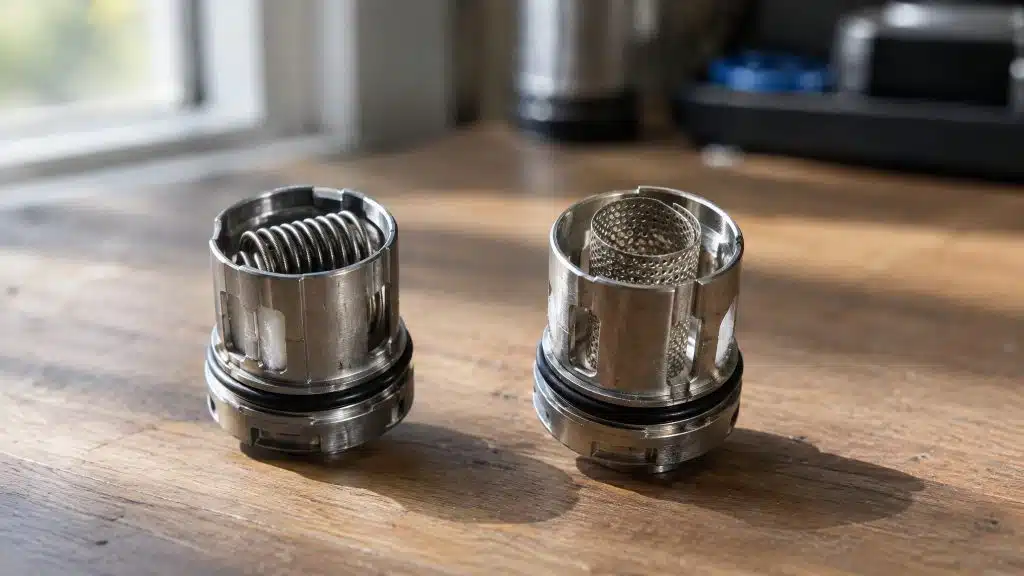
Standing at the counter with a wall of coils in front of you, the mesh coil vs Kanthal coil choice can feel like a bigger decision than it is. It isn’t. Once you know what each term actually means, the rest falls into place.
Here’s the plain version, the same one we’d give you across the counter in Larnaca.
What a mesh coil and a Kanthal coil actually are
The two words answer different questions. Mesh describes a shape: a perforated or woven sheet of metal, rather than a wire wound into a spiral. Kanthal describes a material: an iron-chromium-aluminium alloy, usually drawn into wire.
So they aren’t direct opposites. Mesh coils are usually made from stainless steel, nickel or titanium, which means you’re comparing a construction against an alloy.
A Kanthal coil is typically a wound wire. A mesh coil is a flat sheet, often rolled into a curve inside the coil head. Same job, different build.
How heat and surface area shape flavour
Flavour comes from how well the coil heats the wick and the juice in it. Surface area, wicking and power all play a part, and the metal is only one piece of that.
Why mesh heats evenly across a larger area
A mesh sheet touches far more of the wick than a thin wire does. That larger surface often lets it heat up faster and more evenly, so more of the juice vaporises at once and you get a fuller, smoother hit.
Many vapers find mesh gentler on the throat at the same power. The catch is that the wick has to keep up, because if the cotton can’t feed that big surface quickly enough, the flavour drops off and the taste turns harsh whichever coil you’re using.
Kanthal coil flavour: what to really expect
A wound wire has less contact with the wick, so the heat is more concentrated. Plenty of people describe Kanthal as more focused at moderate power, with clearer individual notes in a juice.
Kanthal is also affordable, durable and easy to find, which is why it has been the default for so long. Iron-chromium-aluminium wire forms a protective oxide layer when it heats, and that helps explain why it holds up so well in wound coils.
Be careful with the “mesh wins on flavour” line, though. The gap is often smaller than people expect, and your e-liquid, your wicking and your power setting usually change the taste more than the metal does. If you want to test that, try a different juice before you blame the coil, and have a look at our favourite fruit e-liquid flavours for ideas.
Coil resistance explained: ohms, power and your device
Resistance is measured in ohms, and it’s the number printed on every coil. It matters more than the material when it comes to what your device can safely run.
What ohms actually tell you about heat
Think of ohms as a dial that sets how much heat a coil makes at a given battery output. Lower resistance lets more current flow, so the coil gets hotter and makes more vapour, and it also drains the battery faster.
Higher resistance does the opposite. That’s why mouth-to-lung tanks, with their tighter draw, usually run higher-resistance coils, while sub-ohm setups, built for bigger clouds, sit lower. If you’re after a tight, cigarette-style draw, our guide to beginner MTL tanks in Cyprus shows what that looks like in practice.
Mesh heads tend to be low-resistance. Kanthal can be wound to many different values on a rebuildable, which is part of its appeal for tinkerers.
Matching a coil to your device safely
Your device or tank sets the safe window, and the coil has to fit inside it. Stay within the resistance range printed on it, because a coil below the minimum can stress the battery and the device.
That’s the first thing we check at the counter, before anything about flavour. Look at the printing on your tank or the manual and write the range down before you shop.
A coil that fits the range is safe to fit. A coil that sits outside it isn’t, however good the reviews are.
Mesh coil lifespan versus Kanthal coil: what wears them out
People often ask which one lasts longer. Honestly, neither is guaranteed to. Lifespan depends more on how you vape than on what the coil is made of.
What actually shortens a coil’s life
High power, dry hits, thick sweet juices and a dirty wick wear out both types. Sugar from sweet juices cakes onto the coil and wick, and a coil that burns dry gets damaged fast.
Picture a switcher who buys a mesh head for the flavour, runs it hard and gets a burnt taste within days. The usual fix is lower power and fresh wicking rather than a different metal, and the same lesson holds for Kanthal.
There is one practical difference. A pre-built mesh head is usually swapped as a unit, while a hand-built Kanthal coil can be rewrapped with fresh wire and cotton. That can matter if you’re watching what you spend, and our look at the running costs of refillable pods versus disposables covers how replacement coils add up.
Signs it’s time to replace the coil
The signs are the same for both types:
- A flat, muted or burnt taste, even with fresh juice
- Vapour that has thinned out
- A gurgling or spitting sound that wasn’t there before
- A hit that feels harsher than it used to
If you see one of these after a fresh refill and a proper prime of the wick, change the coil. Don’t push on with it, because a tired coil only tastes worse.
Best coil material: what each metal means for your setup
There’s no single best coil material. The best metal is the one your device supports and your taste favours.
Kanthal and Nichrome are the usual wires for standard wound coils. Nichrome is a nickel-chromium alloy and Kanthal is iron-chromium-aluminium, and both work well when you’re vaping by wattage. Stainless steel, nickel and titanium turn up in mesh and in temperature-control kit.
Stainless steel is the flexible one, since many devices accept it in either power or temperature mode. Nickel and titanium are mainly used with temperature control, and they’re only worth buying if your device has that feature.
Why temperature control rules Kanthal out
Temperature-control devices read the coil’s resistance as it heats, and they use the change to hold a set temperature. That only works if the metal’s resistance shifts noticeably as it warms.
Kanthal and Nichrome barely shift, so the device has nothing to read. That’s why manuals for temperature-control kit usually list nickel, titanium and stainless steel as compatible and leave Kanthal and Nichrome off the list. Check your own device’s manual before you buy a coil for it.
Which coil suits you: switchers, newcomers and hobbyists
If you’ve just moved from cigarettes, or you’re brand new to vaping, a pre-built coil in the range your device recommends is usually the best place to begin. You don’t build anything, you don’t measure anything, and you swap the head when it wears out.
Hobbyists are a different story. If you enjoy tuning, a rebuildable lets you wind Kanthal or lay in a mesh strip and chase the exact flavour and vapour you want. It’s not for someone who just wants a device that works, because it takes patience and the odd failed build.
Starting out: why a pre-built coil keeps things simple
A pre-built head takes the guesswork out. Someone has already matched the resistance, wicked it and tested it, so you drop it in, prime it and vape.
You give up a little flavour tuning in exchange for simplicity, and for most people in their first few months that’s a good trade. You can always move on later.
Sitting somewhere in between? Our comparison of rebuildable atomisers versus pre-built coils will help you decide whether building is worth the effort.
Bring your device in before you buy
The easiest way to get this right is to let us look at what you’re actually using. Pop into the shop in Larnaca with your device and we’ll have a quick look with you, no pressure to buy anything.
Here’s what we can check:
- The resistance range your device or tank can handle
- Whether it’s built for mouth-to-lung or direct-to-lung vaping
- Whether it supports temperature control
If you’d rather not turn up on the off chance, reserve a visit through WhatsApp and we’ll have things ready. Living nearer Oroklini? You’re just as welcome, and a short drive is worth it for buying online or in store in Larnaca, because you get an answer on the spot instead of a returns form.
Frequently asked questions
Are mesh coils better for vaping?
Not automatically. Mesh often heats faster and more evenly, and many vapers find it smoother on the throat, but the wick, your power setting and your e-liquid shape the result just as much. It’s worth trying if you like fuller flavour on a sub-ohm setup, though it won’t fix a poor wick or a power setting that’s too high.
Is Nichrome or Kanthal better?
Neither wins outright. Both are wound-wire alloys that suit standard wattage-based coils, and most vapers will struggle to tell them apart. Neither works for temperature control, so if your device has that mode you’ll want nickel, titanium or stainless steel instead.
What is the best type of coil for vaping?
The best coil is the one that sits inside the resistance range printed on your device or tank and suits how you vape. For most beginners that means a pre-built coil in the recommended range. Hobbyists who like to tinker often prefer Kanthal or mesh on a rebuildable.
How do I find out what resistance my device can handle?
Check the range printed on your device or tank, or look in its manual. Stay inside that range, because a coil below the minimum can stress the battery and device. Or bring the device into our Larnaca shop and we’ll read it with you.